
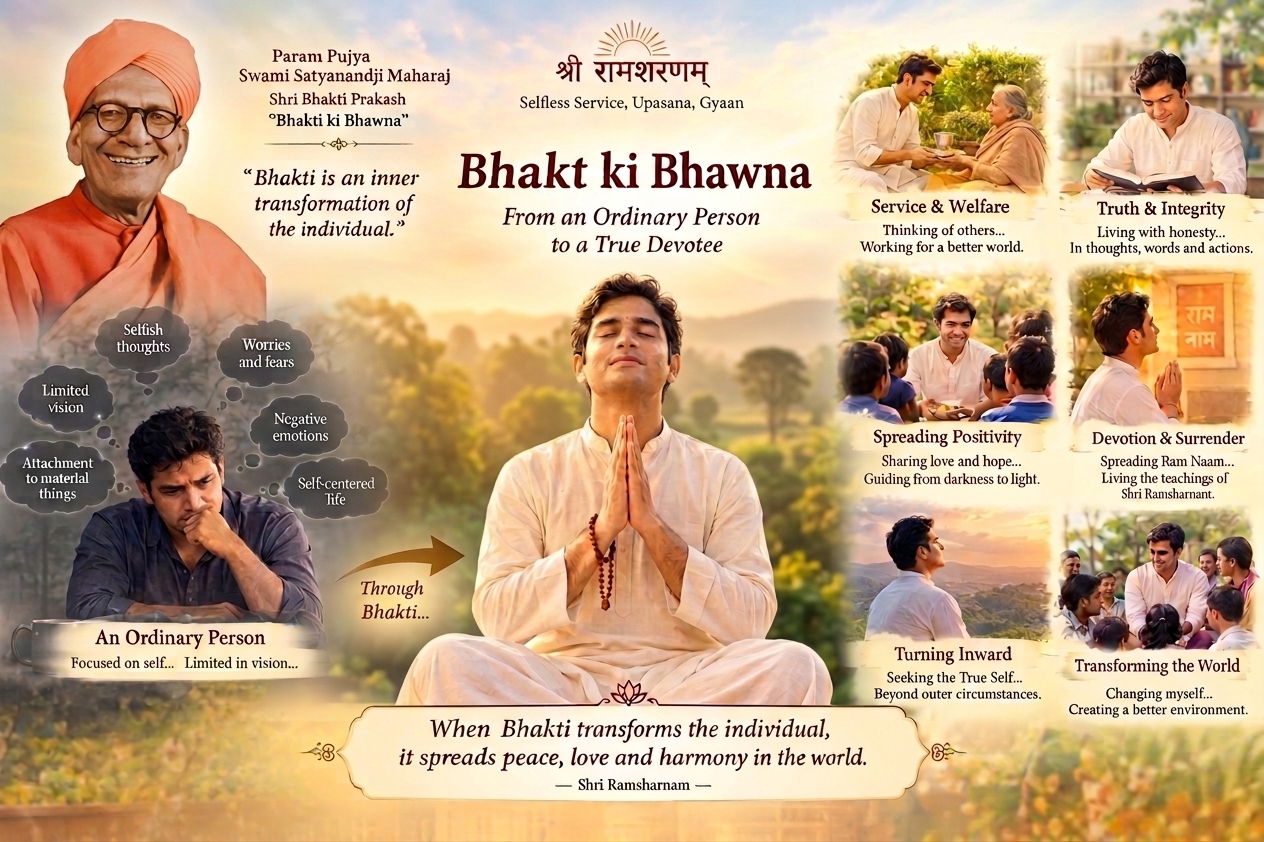
Bhakt ki Bhawna
Swami Satyanandji Maharaj, in the chapter “Bhakt Ki Bhawna” (The Inner Feeling of a Devotee) from Shri Bhakti Prakash, has described in great depth the true nature of a devotee and the inner state of his or her mind.
Swamiji Maharaj explains that when an ordinary person, through self-study (Swadhyaya), spiritual worship (Upasana), and the pursuit of spiritual knowledge (Gyaan), begins to progress on the spiritual path with complete dedication, faith, and unwavering conviction—and remains steadfast with sincerity, discipline, complete surrender, and detachment—then that person gradually enters the state of a Bhakt, a true devotee.
From that point onward, the way the devotee looks at the world and worldly life begins to change. The devotee develops a broader vision, begins to see the underlying unity in all beings, and walks increasingly upon the path of Truth.
The Devotee’s Vision and Compassion
From the perspective of Swami Satyanandji Maharaj’s teachings, as a seeker progresses through Ram Naam, Swadhyaya, Upasana, and Gyaan, a gradual transformation takes place within.
The seeker no longer looks at the world merely through names, forms, relationships, and external identities. Instead, the seeker begins to perceive the presence and reflection of the One Supreme Truth in every being.
1. The All-Encompassing Vision — Seeing the One in All
The vision of a devotee is no longer narrow or limited. For the devotee, Brahm is not confined to a temple, a particular place, or a particular form.
The devotee gradually begins to experience that the same Divine Consciousness dwells within all.
“The One whom I am seeking as Ram is the very same Ram who dwells within every heart.”
It is from this realization that true compassion arises.
When a devotee sees another person suffering, that suffering is no longer perceived merely as “someone else’s suffering.” A natural sensitivity and compassion arise within the heart.
As the sense of separation diminishes, the experience of oneness gradually deepens.
The devotee begins to see beyond external differences and recognizes the same Divine presence expressing itself through different names, forms, circumstances, and personalities.
2. Compassion — The Natural Expression of Devotion
Devotion is not merely a state of emotional absorption or religious feeling.
If the practice of Ram Naam does not gradually give rise to love, humility, patience, tolerance, and compassion within us, then the seeker should look inward and reflect upon how deeply the spiritual practice has entered into daily life.
A true devotee gradually reduces harshness, hatred, resentment, and hostility toward others.
The devotee understands that every individual is living according to his or her own circumstances, impressions, experiences, and level of understanding.
Therefore, instead of immediately judging others, the devotee develops greater patience, understanding, forgiveness, and compassion.
This transformation is one of the signs that Bhakti is becoming a living experience rather than remaining merely a practice.
3. The Feeling of Universal Welfare — “Not Only Me, May Everyone Be Happy”
The devotee does not desire happiness only for himself or herself.
The devotee wishes that no one in the world should suffer unnecessarily; that there should be love within families, brotherhood among people, peace in society, and that everyone should have access to the basic necessities of life.
The devotee’s heartfelt wish becomes:
May there be happiness in everyone’s life, peace in every heart, food in every home, love in every mind, and faith in Truth and the Divine awakened within everyone.
This feeling does not remain merely a thought or a prayer.
It inspires the devotee toward Seva (selfless service) and Lok-Kalyan (the welfare of all).
Thus, the expansion of the heart becomes visible through action.
4. Health, Food, and Social Harmony
If a person is hungry, suffering, lonely, or deeply distressed, merely giving that person spiritual teachings is not sufficient.
Compassion means making a sincere effort, wherever possible, to reduce another person’s suffering.
Therefore, the devotee’s भावना—inner feeling and attitude—also includes the wish that:
- Everyone should have sufficient food and water.
- People should remain healthy and safe.
- Love and respect should prevail within families.
- Cooperation, harmony, and brotherhood should grow within society.
- People should learn to understand and share in one another’s suffering.
- Truth, morality, integrity, and honesty should flourish.
- Faith in the Divine and in Truth should awaken within people.
For the devotee, spiritual growth and the welfare of humanity are not separate concerns. The awakening taking place within should naturally express itself through compassion and service outside.
The Heartfelt Prayer — The Light of Ram Naam
At the very center of all these feelings lies the devotee’s deepest prayer—Ram Naam.
The devotee does not wish merely for external circumstances to improve. The deeper wish is that the inner light of awareness may awaken within every human being, enabling each person to recognize his or her true nature.
Therefore, a prayer arises from the heart:
“O Ram! May the light of Ram Naam be kindled in the hearts of all. May every person recognize the Divine Consciousness within. May the dormant inner strength awaken, and may each person experience his or her true nature.”
From the Shri Ramsharnam perspective, Seva, Bhakti, and Gyaan are not separate from one another.
There should be Ram Naam within, expressed through spiritual practice, and love, service, compassion, and harmony without, expressed through daily living.
This harmony between inner realization and outer conduct is a sign of the maturing of Bhakti.
The devotee's spiritual journey therefore becomes an inward transformation:
Ram Naam → Inner Purification → Transformation of Vision → Compassion → Seva → Universal Welfare → Recognition of the True Self
In this way, Bhakt Ki Bhawna is not merely an emotional or devotional sentiment. It becomes a way of seeing, thinking, living, serving, and ultimately experiencing the Oneness of the Divine in all.